CAMERA Joins International Team to Solve Virtual Production’s Tracking Problem
News
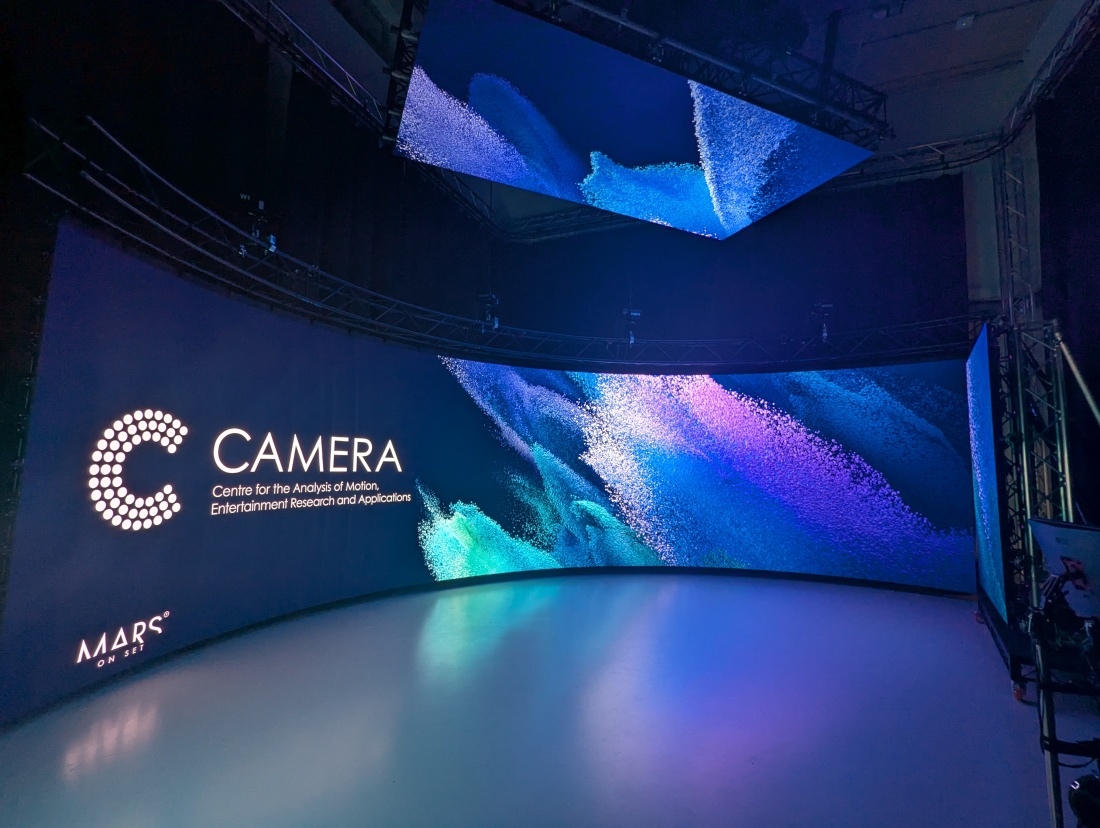
A new international research collaboration between CAMERA at the University of Bath, University of the Fraser Valley and Breda University of Applied Sciences is investigating one of virtual production’s most persistent and costly problems: what happens when your camera tracking fails.
Tracking failure – whether through occlusion, calibration drift, or hardware issues – remains one of the most disruptive things that can go wrong on a virtual production shoot. Most productions rely on a single tracking system, and when that system encounters problems, the consequences can be immediate and expensive. The collaboration, led by Carlos Vilchis, Ph.D. Professor at UFV, investigates whether combining multiple tracking approaches into a single, resilient hybrid workflow can give productions something they currently lack: a reliable fallback when conditions on the floor stop being ideal.
“Virtual production has reached an exciting point of maturity, but one of its weakest links is still the assumption that a single tracking system will always be enough. This research matters to me because it addresses a problem that productions face in the real world, not just in ideal conditions. The international nature of the collaboration is essential, because it allows us to combine different technical cultures, production experiences, and research priorities. Ultimately, I hope this project helps the industry think less in terms of isolated technologies and more in terms of resilient ecosystems that make virtual production more robust, more scalable, and more accessible,” said Carlos Vilchis, Ph.D., UFV
What gives the research its practical weight is its insistence on testing under real production conditions rather than controlled benchmarks. The aim is not just to publish findings but to work towards something productions can actually use.
“One of CAMERA’s core aims is to support research that has genuine relevance for the industry, and this collaboration is a great example of that in practice. It addresses a problem that practitioners deal with regularly but that hasn’t received the serious research attention it deserves. What excites us most is the potential this work has to open up new lines of research into how productions plan and future-proof their stages, and we are looking forward to seeing where it takes us,” said Graham Oliver, Studio Engineer and VP Lead at CAMERA.
The longer-term implications are perhaps the most compelling part. High-end optical tracking infrastructure remains expensive, and that cost puts a ceiling on who can do serious virtual production work. If hybrid approaches can deliver comparable resilience at lower cost, the research could contribute to something bigger than any single production: a more accessible field.
To find out more about this project or CAMERA’s virtual production research, get in touch at [email protected]